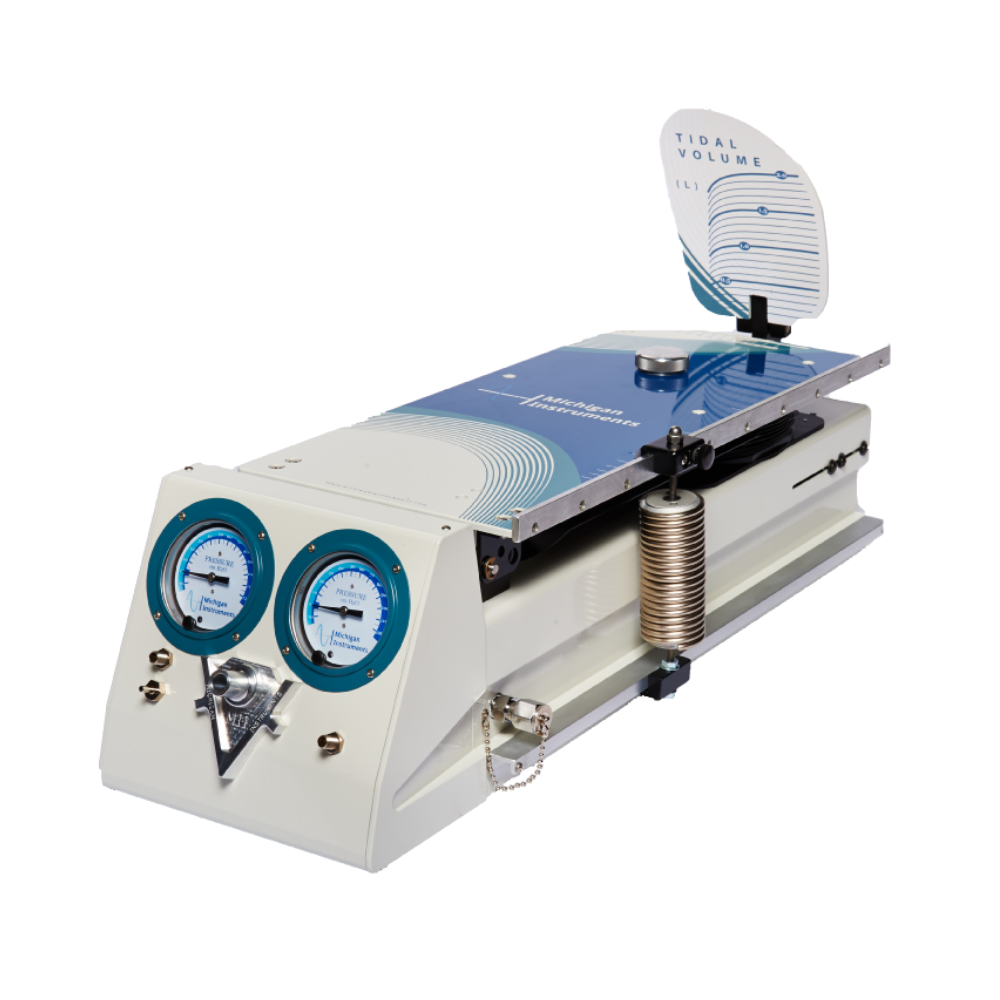
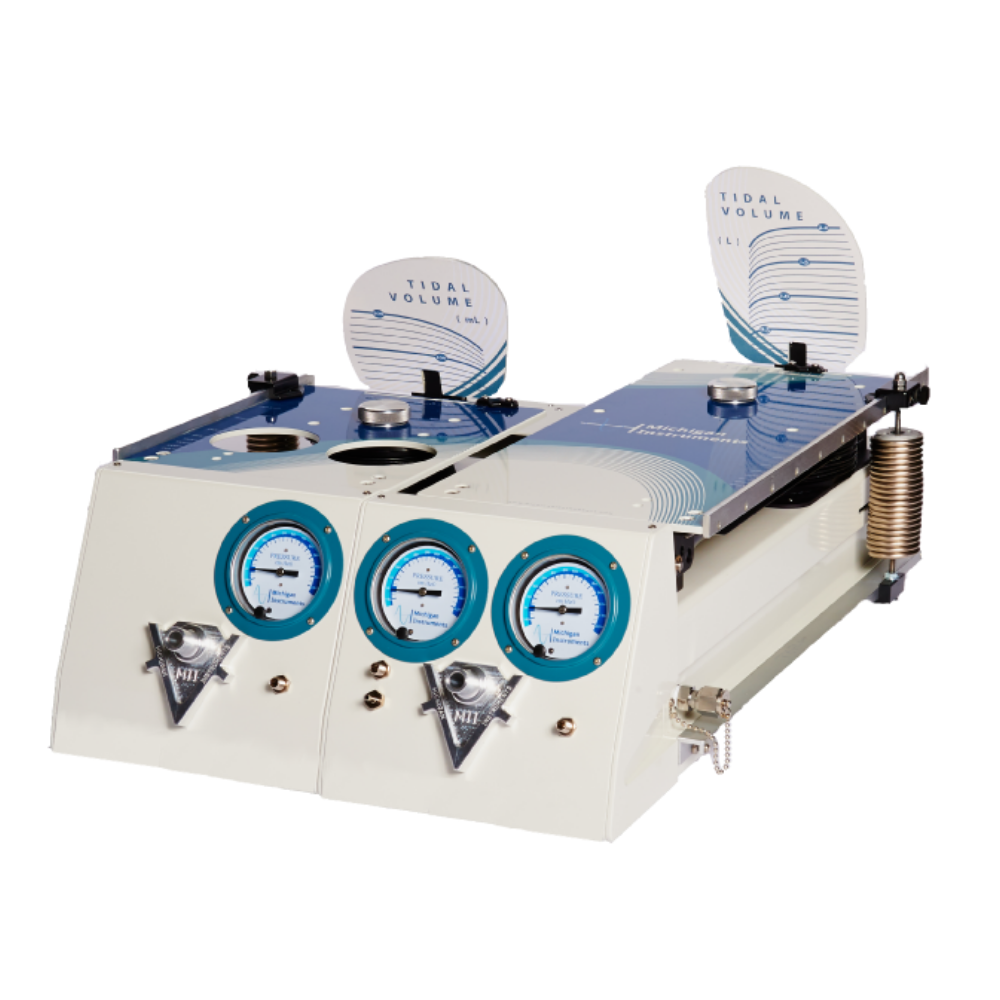
Lung Simulators for Training, Testing, and Research
“Michigan Instruments has the best test lung. They are easy to use and durable. We wish we had more!”
Ann Flint, Grand Valley University

“Michigan Instruments has the best test lung. They are easy to use and durable. We wish we had more!”
Ann Flint, Grand Valley University
“We use the Michigan Instruments Test Lungs/Lung Simulators (TTL) in our program for demonstration for mechanical ventilation, laboratory practice with ventilators, and aerosol and ventilator research. The TTL is valuable in showing students the effects of changes in compliance and resistance on volume and pressure. They are also valuable to show differences between tracheal and intrapulmonary pressure.”
Tim Op’t, EdD, RRT, AE-C, FAARC
Professor and Chair, Cardiorespiratory Care – University of South Alabama
Because they behave differently.
Unlike simplified test lungs, our simulators include realistic residual lung volumes and lifelike responsiveness to therapy.
When ventilated, they move and react like real lungs, helping users trust what they’re seeing and measuring.
Each device is fully calibrated and includes a Certificate of Calibration. We recommend recalibration every two years.
Mechanical simulation without electronics
TTL simulation with integrated electronics and software
Includes all TTL features, plus:
Designed for users who need measurable, visualized data alongside realistic mechanical simulation.
We know budgets are tight, approval cycles take time, and equipment has to last.
That’s why Michigan Instruments focuses on building durable, reliable tools that integrate easily into real-world workflows and continue performing year after year.
Tell us what you need to teach, test, or evaluate. We’ll help you configure a solution that fits your environment and your goals.
“Reliable, proven and universally accepted”.
Neil Euliano, Convergent Engineering.
Click on the question below to see the answer. If you have a specific question, please contact us directly.
How do I choose the right lung simulator?
The right lung simulator depends on how you plan to use it. First, choose your configuration: Single Adult, Dual Adult or the Adult-Infant for the widest range available. Next decide if you want a TTL or PneuView version. They both provide the same fully adjustable and realistic mechanical representation of the human pulmonary system. The TTL provides analog readings while the PneuView systems add electronic measurement and data visualization for testing and analysis. Finally, if you want spontaneous breathing capability, be sure to include the Spontaneous Breathing Lung (SBL) module (an available addition to all TTL and PneuView devices).
Can’t Decide? Contact us, we would be happy to talk it through with you.
Why does realistic lung behavior matter in training and testing?
Realistic lung behavior helps users see and feel how ventilators interact with actual pulmonary mechanics. Simulators that respond dynamically to changes in compliance and resistance reinforce correct decision-making, improve skill transfer to clinical settings, and support accurate device evaluation. Without realistic behavior, training and testing results can be misleading.
Can one lung simulator support multiple use cases?
Yes. Michigan Instruments lung simulators are designed to support training, testing, and research using a single platform. Adjustable compliance and airway resistance settings allow users to simulate a wide range of lung conditions, making the same device suitable for classrooms, hospital labs, biomedical engineering work, and device development.
What makes Michigan Instruments’ lung simulators different from other test lungs?
Michigan Instruments lung simulators are fully to scale, include realistic residual lung volumes, and provide a wider range of calibrated compliance and resistance settings than many basic test lungs. They move and respond like real lungs when ventilated, which improves training realism and measurement confidence across repeated use.
Learn why educators, engineers, researchers, and clinicians worldwide rely on Michigan Instruments lung simulators for accurate, repeatable respiratory simulation.