
High-quality CPR is the foundation of cardiac arrest care. In most situations, trained providers will deliver manual chest compressions when they can do so safely and effectively.

But not every resuscitation is equal.  Here are some situations that create a challenge when providing manual CPR.

During Patient Transport

Performing manual CPR inside a moving ambulance presents challenges for both patients and responders. Space is limited, the vehicle is moving, and providers may have difficulty maintaining a stable position while delivering consistent compressions.

The AHA identifies patient transport as one situation where mechanical CPR may help support CPR quality as manual compressions may be difficult to perform safely. Agencies should consider factors such as transport time, crew safety, available personnel, and the potential for interruptions when deciding whether to use mechanical CPR.

Michigan Instruments mechanical CPR devices are designed for use during transport, providing consistent compressions while allowing responders to focus on other aspects of patient care.

In Confined or Difficult-to-Reach Spaces

Cardiac arrests do not always happen in locations where providers can easily position themselves beside the patient. Resuscitation may take place in confined spaces, during search and rescue operations, or in other unusual environments.

The AHA specifically recognizes confined spaces and special transport situations as circumstances where alternative CPR techniques may be needed. Mechanical CPR can provide another option when the environment makes standard manual compressions difficult or unsafe.

During Prolonged Resuscitations

Manual CPR is physically demanding, and fatigue can make it more difficult for providers to maintain consistent compressions over an extended resuscitation.

Mechanical CPR can provide consistent compressions without relying on a provider to maintain physical effort throughout the entire resuscitation. This can allow other members of the care team to focus on airway management, medications, rhythm assessment, and other critical tasks.

When Crew Safety Becomes a Concern

Provider safety is another important consideration when determining how CPR should be delivered.

Moving vehicles, unstable environments, difficult patient locations, and other logistical challenges can make manual compressions more difficult or increase the risk to responders.

Supporting the Care Team

Cardiac arrest management requires more than chest compressions. EMS providers may also need to manage the airway, administer medications, analyze cardiac rhythms, communicate with receiving facilities, and prepare the patient for transport.

When mechanical CPR is appropriate, it can help reduce the physical demands of continuous compressions and give providers greater access to other aspects of patient care.

Michigan Instruments Life-Stat® is an oxygen-powered mechanical CPR system designed to provide consistent compressions for adult cardiac arrest patients, while also allowing the space to utilize an AED without losing compression time.

Choosing the Right Approach for the Situation

Every cardiac arrest is different.  Manual CPR remains fundamental to resuscitation and Mechanical CPR is not intended to replace manual CPR.   Instead, mechanical CPR may be considered when high-quality manual compressions are challenging or dangerous.

EMS agencies should consider their protocols, available personnel, transport conditions, training, and patient circumstances when determining when mechanical CPR may be appropriate.

Life-Stat® provides EMS teams with an oxygen-powered mechanical CPR option for situations where manual compressions may be challenging, including transport and extended resuscitations.

Contact Michigan Instruments to learn how Life-Stat® can support your EMS team’s cardiac arrest response.
Simulation-based training helps respiratory therapists prepare for complex patient care. Learn how lung simulators recreate realistic respiratory conditions to improve ventilator management skills, clinical confidence, and hands-on education.

Oxygen-powered automated CPR devices like the Life-Stat® 1008 integrate mechanical compressions and ventilation into hospital workflows, supporting consistent, guideline-aligned resuscitation performance during critical care events.

Automated CPR in hospitals helps reduce staff fatigue while delivering consistent, guideline-aligned chest compressions during cardiac arrest. By minimizing interruptions and supporting uninterrupted performance during extended codes, mechanical CPR devices improve efficiency and clinical focus. Learn how automated CPR supports both patient outcomes and safer working conditions for care teams.

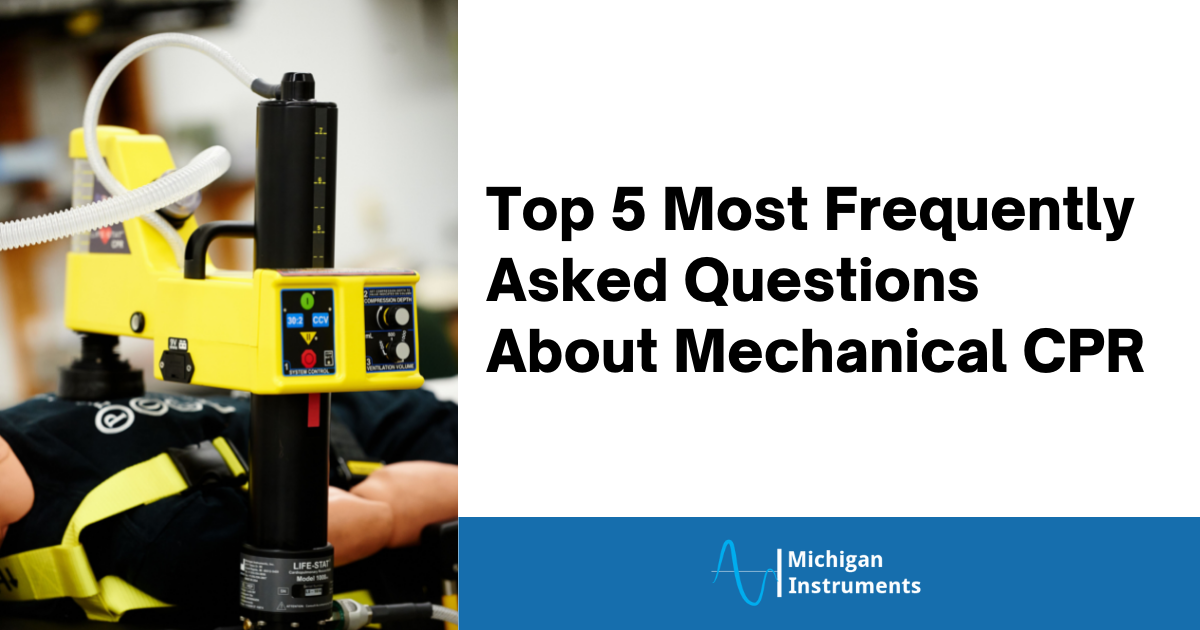
Mechanical CPR Most Frequently Asked Questions

Mechanical CPR has been around since the 1960s, starting when we made an oxygen-powered piston on an adjustable arm to deliver compressions called the Thumper®.

As a company that specializes in automated CPR devices and lung simulators, we receive many questions from medical professionals and educators alike surrounding this device. 

Below, we outlined the most frequently asked questions about mechanical CPR. 

1. Can I Trade In My Old Automated CPR Device?

Yes! At Michigan Instruments, we offer a trade-in allowance for any manufacturer’s automated CPR device.

Just make sure to let us know when requesting a quote if you’re upgrading an older CPR device, or have one already out of service.

Have more questions or want to learn more? Visit our FAQ page for more information.

2. How Does the Life-Stat® Fully Meet the 2015 AHA Guidelines?

As outlined in the 2015 American Heart Association (AHA) guidelines, the Life-Stat® is capable of providing both Basic Life Support (BLS) and Advanced Life Support (ALS) cardiopulmonary resuscitation protocols. 

This is achieved by using an electronic timing control powered by 2 inexpensive 9-volt alkaline batteries.

3. What are the Dimensions and Weight of the Life-Stat®?

The Life-Stat® CPR measures at:

  • 22-½” (57.2 cm) in height
  • 7-⅝” (19.4 cm) in width
  • 18-¼” (46.4 cm) in length
  • 19 lbs (8.6 kg) in weight

Have more questions or want to learn more? Visit our FAQ page for more information.

4. Can the Life-Stat® Be Used on Infants or Children?

No. Current AHA guidelines do not recommend the use of mechanical CPR on infants or children.

5. What are the Comparisons Between the Thumper® and Life-Stat® CPR?

While both the Thumper® and Life-Stat® are quite similar, there is one key difference between them — ventilation is not applicable with the Thumper®, whereas the Life-Stat® delivers volume-based ventilation.

Below is a table comparing the Model 1007 Thumper®s to the Model 1008 Life-Stat®.

Thumper® MODEL 1007CC Life-Stat® MODEL 1008
Compression Depth Control Up to 5 turns or 0 to 8 cm of depth Up to 5 turns or 0 to 8 cm of depth
Arm Lock Mechanism Requires only one turn from lock to unlock position Requires only one turn from lock to unlock position
Pressure Regulation Built-in pressure regulator and pressure relief valve to prevent damage Built-in pressure regulator and pressure relief valve to prevent damage
Pressure and Flow Visual indicator for correct input pressure Visual indicator for correct input pressure
Ventilation Not applicable Delivered volume-based ventilation
Storing Stores in “use” position Stores in “use” position

Have more questions or want to learn more? Visit our FAQ page for more information.

Have More Questions? Contact Michigan Instruments Today!

To learn more about how our automated CPR devices have helped EMS professionals, doctors and nurses provide patients with high quality care for over 55 years, please visit our FAQ page or contact us today.