Training for the Unpredictable: Simulating ARDS, COPD, and Evolving Disease States
Respiratory emergencies don’t follow a script. Conditions such as Acute Respiratory Distress Syndrome (ARDS) and COPD can evolve from stable to critical, challenging even experienced clinicians. To stay ready, educators and care teams need more than routine drills—they need training that mirrors the complexity and sudden changes of real patients.
Bringing Real-World Complexity Into the Lab
Traditional practice often focuses on static scenarios, but real lungs rarely behave the same way twice. With advanced lung simulation, instructors can create sessions where compliance, resistance, and breathing patterns change as they would in an actual patient.
This kind of dynamic training helps participants:
- Spot subtle indicators of deteriorating lung function
- Adjust ventilator settings or manual ventilation techniques quickly
- Coordinate responses across the care team when conditions escalate
Instead of practicing isolated skills, providers build the adaptability and problem-solving needed for unpredictable disease progression.
Preparing for a Wide Range of Conditions
Every respiratory disorder presents its own challenges. ARDS often brings sudden drops in oxygenation, while COPD may involve chronic obstruction and high airway resistance. Our to replicate both and many other clinical pictures with precision.
By altering parameters during a session, instructors can demonstrate and teach:
- Early ARDS onset followed by worsening compliance
- COPD exacerbations with increasing resistance
- Multi-stage scenarios where treatments must evolve in real time
These exercises demonstrate how to read the situation, not just follow a checklist.
Simulation Tools That Adapt as Fast as Patients
Our TTL® , PneuView® and Spontaneous Breathing Lung Simulators are designed for flexibility and accuracy. Features that make them ideal for evolving-disease training include:
- Real-time adjustability for resistance and compliance
- Dual-lung configurations for asymmetric or dual-patient ventilation scenarios
- Precise volume and pressure responses to any ventilator or manual device
- Analog or digital interfaces for data capture and immediate feedback
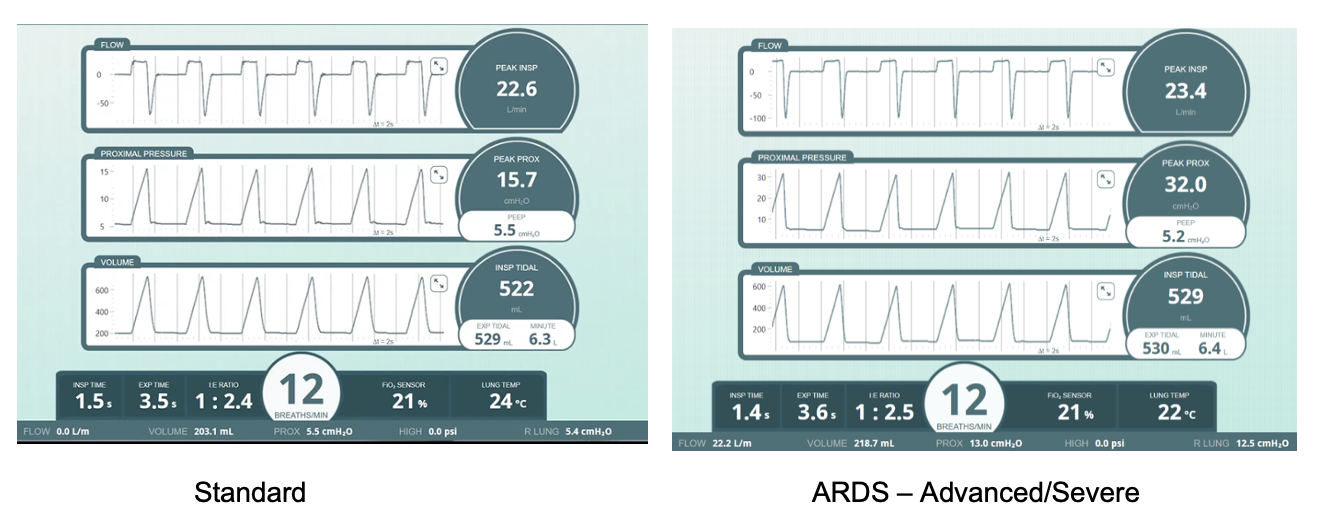
Using the PneuView System, check out below the changes in the data when the user changes the compliance to simulate Advanced ARDS.
This versatility supports a wide spectrum of users, from respiratory therapy students to seasoned critical-care teams, while ensuring each session can be tailored to specific learning objectives.
Confidence Built on Practice
When clinicians can rehearse complex, changing conditions in a controlled setting, they develop the agility and confidence to make rapid, life-saving decisions at the bedside. Michigan Instruments lung simulators provide the realism and flexibility to make that possible—preparing teams to handle whatever comes next.
Ready to train for the unexpected? Discover how Michigan Instruments lung simulators can help your program create truly adaptive ARDS simulation, COPD simulation, and other evolving-disease scenarios.

