
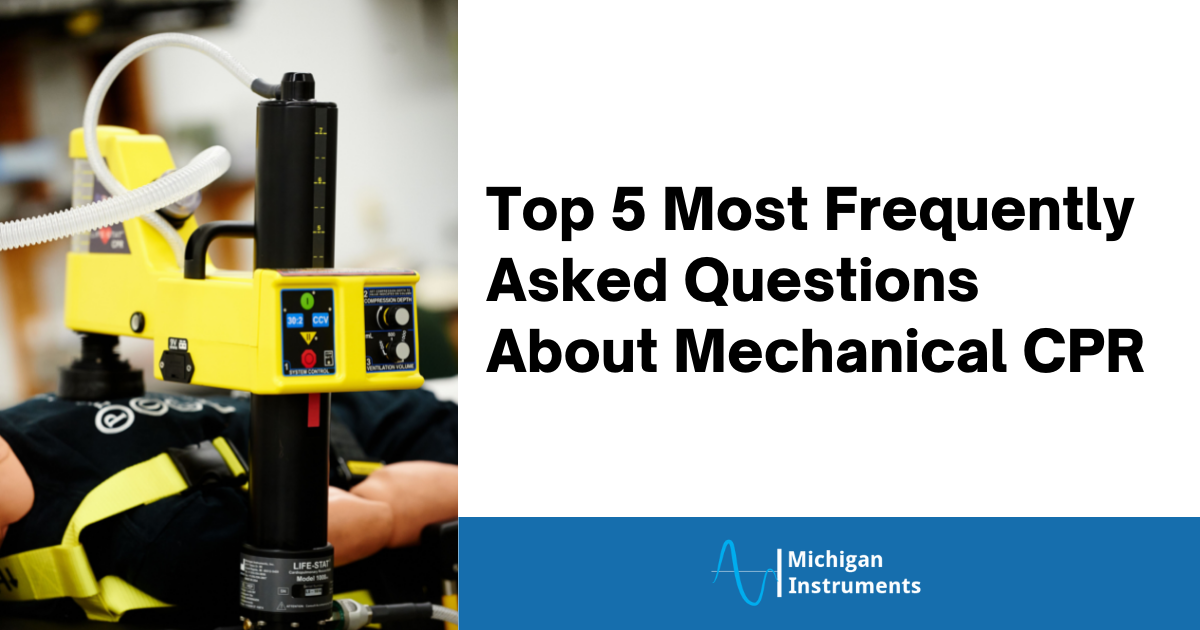
Mechanical CPR Most Frequently Asked Questions

Mechanical CPR has been around since the 1960s, starting when we made an oxygen-powered piston on an adjustable arm to deliver compressions called the Thumper®.

As a company that specializes in automated CPR devices and lung simulators, we receive many questions from medical professionals and educators alike surrounding this device. 

Below, we outlined the most frequently asked questions about mechanical CPR. 

1. Can I Trade In My Old Automated CPR Device?

Yes! At Michigan Instruments, we offer a trade-in allowance for any manufacturer’s automated CPR device.

Just make sure to let us know when requesting a quote if you’re upgrading an older CPR device, or have one already out of service.

Have more questions or want to learn more? Visit our FAQ page for more information.

2. How Does the Life-Stat® Fully Meet the 2015 AHA Guidelines?

As outlined in the 2015 American Heart Association (AHA) guidelines, the Life-Stat® is capable of providing both Basic Life Support (BLS) and Advanced Life Support (ALS) cardiopulmonary resuscitation protocols. 

This is achieved by using an electronic timing control powered by 2 inexpensive 9-volt alkaline batteries.

3. What are the Dimensions and Weight of the Life-Stat®?

The Life-Stat® CPR measures at:

  • 22-½” (57.2 cm) in height
  • 7-⅝” (19.4 cm) in width
  • 18-¼” (46.4 cm) in length
  • 19 lbs (8.6 kg) in weight

Have more questions or want to learn more? Visit our FAQ page for more information.

4. Can the Life-Stat® Be Used on Infants or Children?

No. Current AHA guidelines do not recommend the use of mechanical CPR on infants or children.

5. What are the Comparisons Between the Thumper® and Life-Stat® CPR?

While both the Thumper® and Life-Stat® are quite similar, there is one key difference between them — ventilation is not applicable with the Thumper®, whereas the Life-Stat® delivers volume-based ventilation.

Below is a table comparing the Model 1007 Thumper®s to the Model 1008 Life-Stat®.

Thumper® MODEL 1007CC Life-Stat® MODEL 1008
Compression Depth Control Up to 5 turns or 0 to 8 cm of depth Up to 5 turns or 0 to 8 cm of depth
Arm Lock Mechanism Requires only one turn from lock to unlock position Requires only one turn from lock to unlock position
Pressure Regulation Built-in pressure regulator and pressure relief valve to prevent damage Built-in pressure regulator and pressure relief valve to prevent damage
Pressure and Flow Visual indicator for correct input pressure Visual indicator for correct input pressure
Ventilation Not applicable Delivered volume-based ventilation
Storing Stores in “use” position Stores in “use” position

Have more questions or want to learn more? Visit our FAQ page for more information.

Have More Questions? Contact Michigan Instruments Today!

To learn more about how our automated CPR devices have helped EMS professionals, doctors and nurses provide patients with high quality care for over 55 years, please visit our FAQ page or contact us today.

Blog Image

The Benefits to Pre-Hospital Use of Automated CPR Machine

When it comes to cardiac arrest patients, every second and every compression can make a huge difference. However, it can be extremely difficult—sometimes even impossible, for caregivers to deliver consistent, high-quality compressions in pre-hospital settings, especially during transport.

Michigan Instruments Automated CPR devices provide a way for first responders to safely provide continuous CPR to patients throughout pre-hospital care, avoiding any interruptions in life-saving CPR. Here are the benefits to pre-hospital use of automated CPR devices.

Easy to Use, Automated CPR in Seconds

Lightweight and easily transportable, automated CPR devices like our Life Stat and Thumper allow for a quick transition from manual to automated CPR. These CPR machines can easily be incorporated into a hospital “crash cart” setup or stored in most ambulance storage compartments. Automated CPR devices take seconds to set up, making the transition to mechanical CPR seamless and with minimal interruption to compressions.

Uninterrupted, Consistent Chest Compressions

Manual CPR can be physically challenging for caregivers to give for an extended period of time, and fatigue can result in less-than-optimal CPR for patients within minutes. Michigan Instruments automated CPR devices deliver consistent compressions for as long you need, eliminating the risk of burnout and ensuring high quality care to the patient.

Continuous Compressions During Transport

Attempting to deliver quality, manual CPR during transport can be extremely difficult and increase the risk of injury to emergency responders. Michigan Instruments Automated CPR devices are securely attached to patients to avoid any interruptions in CPR for as long as it takes to reach the hospital.

Concentrate on other Life Saving Procedures

Automated CPR devices perform effective and customized CPR hands-free, allowing emergency responders to concentrate and perform other life-saving measures during transport, before the patient even reaches the hospital. If necessary, mechanical CPR can also be paused and resumed with just the push of a button, maintaining nearly complete access to the patient throughout the entire event.

Rely on Michigan Instruments

Michigan Instruments’ automated CPR devices have been helping EMS professionals, doctors and nurses provide their patients with the quality care they deserve for decades. Learn more about our Life Stat and Thumper mechanical CPR devices and contact one of our representatives to learn more, or request a quote today.

Michigan Instruments is a proven partner of hospitals and EMS Units around the globe, helping them provide patients with the best chance of survival through Automated CPR. Our Life-Stat mechanical CPR device provides EMS Units with a device that delivers consistent, uninterrupted CPR care that they can count on and represents our latest advancements in CPR technology.

Here are the 7 reasons your EMS Unit needs a Life-Stat:

1. Meets AHA 2020 Guidelines

Our Life-Stat is the only CPR device on the market that meets the American Heart Association’s 2020 guidelines for both ventilation and chest compressions.

2. Perfect, Hands-Free Automatic CPR

With the Life-Stat, the CPR machine does the work for you! The Life-Stat delivers automatic CPR to the patient and is the only device in the market to offer built-in ventilation. These features allow first responders to focus on other important, and life-saving resuscitation efforts and helps to prevent caregiver fatigue that comes with performing manual CPR. The hands-free design also helps to prevent EMS personnel from being in unsafe positions during patient transport.

3. Provides Improved Patient Access

The Life-Stat makes it so that there is no need to work around people providing chest compressions as you perform life-saving care. Engineered with a “C” arm design, it provides more access to the patient than other wrap-around or enclosed models. It is also easy to use in confined spaces and stairways that EMS personnel can encounter during transport.

If needed, the Life-Stat can be paused and resumed at the push of a button, maintaining nearly complete access to the patient throughout the entire resuscitation effort.

4. Personalized Care for Patients

Offering adjustable compression depth, the Life-Stat clearly shows the compression depth for each patient based on the patient’s specific A-P chest diameter. The design also allows for it to provide care and accommodate larger patients than other CPR devices on the market.

5. It Doesn’t Quit

The Life-Stat provides complete and uninterrupted CPR for as long as you need it.  It has a long lifespan, allowing the Life-Stat to sustain support and ensuring little chance of device failure mid-care.

6. Lightweight and Easy to Use Chest Compression Machine

Being only 19.5 lbs. (or 8.8 kg), the Life-Stat CPR device is lightweight and easy to use, taking only seconds to set up. The device easily fits and is accessible in most ambulance or fire rescue storage compartments and is capable of operating with most standard ambulance oxygen systems.

7. Great Value. Most Cost Effective Automated CPR Device

Michigan Instruments’ automated CPR devices offer the absolute best value in the market today with the lowest acquisition cost. Offering very low, ongoing maintenance costs, the Life-Stat’s 9-volt batteries and ventilation tubes are easy and inexpensive to replace.

Considering Adding or Upgrading Your Mechanical CPR Device?

Trust that your EMS crew and your patients are always in good hands with Michigan Instruments’ Life-Stat or Thumper CPR Devices. Want to learn more about Michigan Instruments or get a quote on a Life-Stat device? Contact us!