
HOUGHTON — As COVID-19 cases have surged, the shortage of working ventilators has become one of the biggest obstacles in treating patients.
A Michigan Technological University professor is one of the people working on a solution. Joshua Pearce, Richard Witte Endowed Professor of Materials Science and Engineering and a professor of electrical and computer engineering, is co-editor in chief of HardwareX, an open-source scientific hardware journal. It is now accepting submissions for an issue with proposals for making ventilators and other necessary equipment, such as non-contact thermometers and N95 respirators. Those can be through 3-D printing, or with materials and tools readily available at hardware stores.
Several previous authors have indicated they will submit papers, Pearce said. One South American researcher is testing an open-source ultraviolet sterilization method that can be used for entire rooms.
“He had done it for biological research, but he’s adapted it for a hospital setting as well,” Pearce said.
Submissions will be taken until June 1, then posted online within a week of their acceptance. HardwareX is making the issue available to all to ensure a fast peer review.
Michigan Tech is also tackling the problem. Pearce runs the Michigan Tech Open Sustainability Technology (MOST) Lab. He is also part of Tech’s Open Source Initiative.
One approach they are working on is recreating a low-cost ventilator used by a Tech Enterprise team that was deployed in Africa.
“That is slightly challenging because we only have access to one of the labs on campus,” Pearce said.
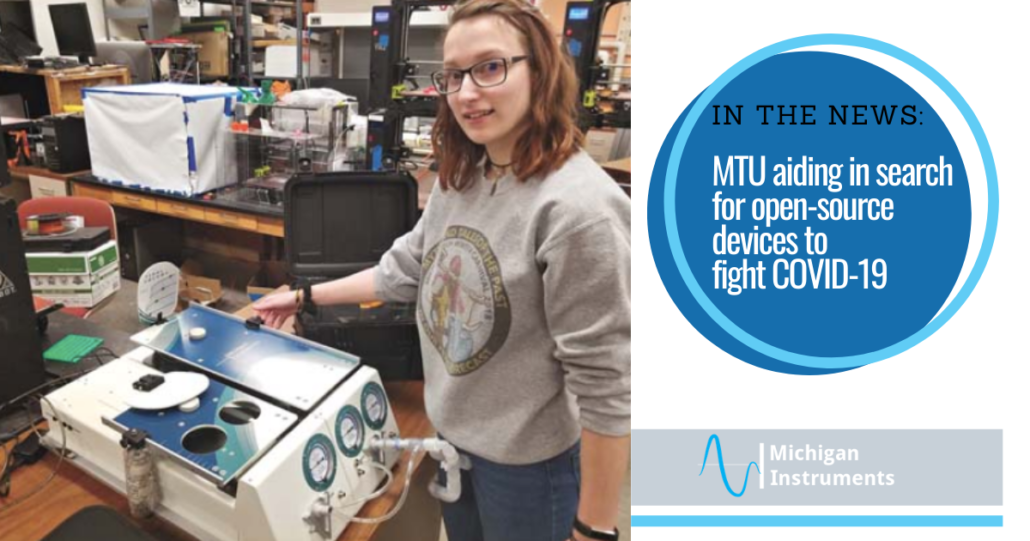
Testing is using artificial lungs from Michigan Instruments to simulate the ventilators’ effect on humans.
“No one is quite there yet,” Pearce said. “It’s very, very challenging on the software side to control the pressures so you don’t damage people’s lungs.”
COVID-19 closures have already caused problems with access to some places. One of the most promising leads was a paper published in 2019 by a research team in Pakistan, with whom Pearce had been working. The team had access to an artificial lung and could run tests immediately. However, their university was shut down due to the pandemic.
“The last version of the code is stuck on some computer at the university, and nobody can get access to it,” Pearce said.
Other researchers are looking at converting a CPAP machine to assist people in breathing.
All of this is taking place when teams are restricted to what Pearce calls “the absolute worst way to do designing”: limits on how many can be in a lab, limited access to equipment and disrupted supply chains. Before the next pandemic, Pearce said, there should be government-funded open-source designs pre-tested and ready to put into place when the need arises.
“That would relieve a lot of the costs associated with having stockpiles, and really help the countries that don’t have the capital to build 10,000 ventilators,” he said.
In March, Pearce conducted a review of open-source ventilators. While promising, he said, the systems that had been tested and peer-reviewed did not have full documentation. Those that were documented were either early designs or had not finished testing.
“With the considerably larger motivation of an ongoing pandemic, it is assumed these projects will garner greater attention and resources to make significant progress to reach a functional and easily replicated open source ventilator system,” he said.
A $1,500 ventilator system being developed by the Innovative Global Solutions Enterprise team at Tech had been one of the furthest along, Pearce said. However, it could not reach its fundraising goal through Superior Ideas, Michigan Tech’s crowdfunding platform.
“If it had been funded, we’d probably have the solution already and we could shop it out,” Pearce said.